

 By
By Boxing is a sport which requires commitment and discipline.
Without discipline you are nothing. Without commitment you are nothing.
I give you 5 Best Boxing exercises that can help you become a boxer.
1. Shadow Boxing
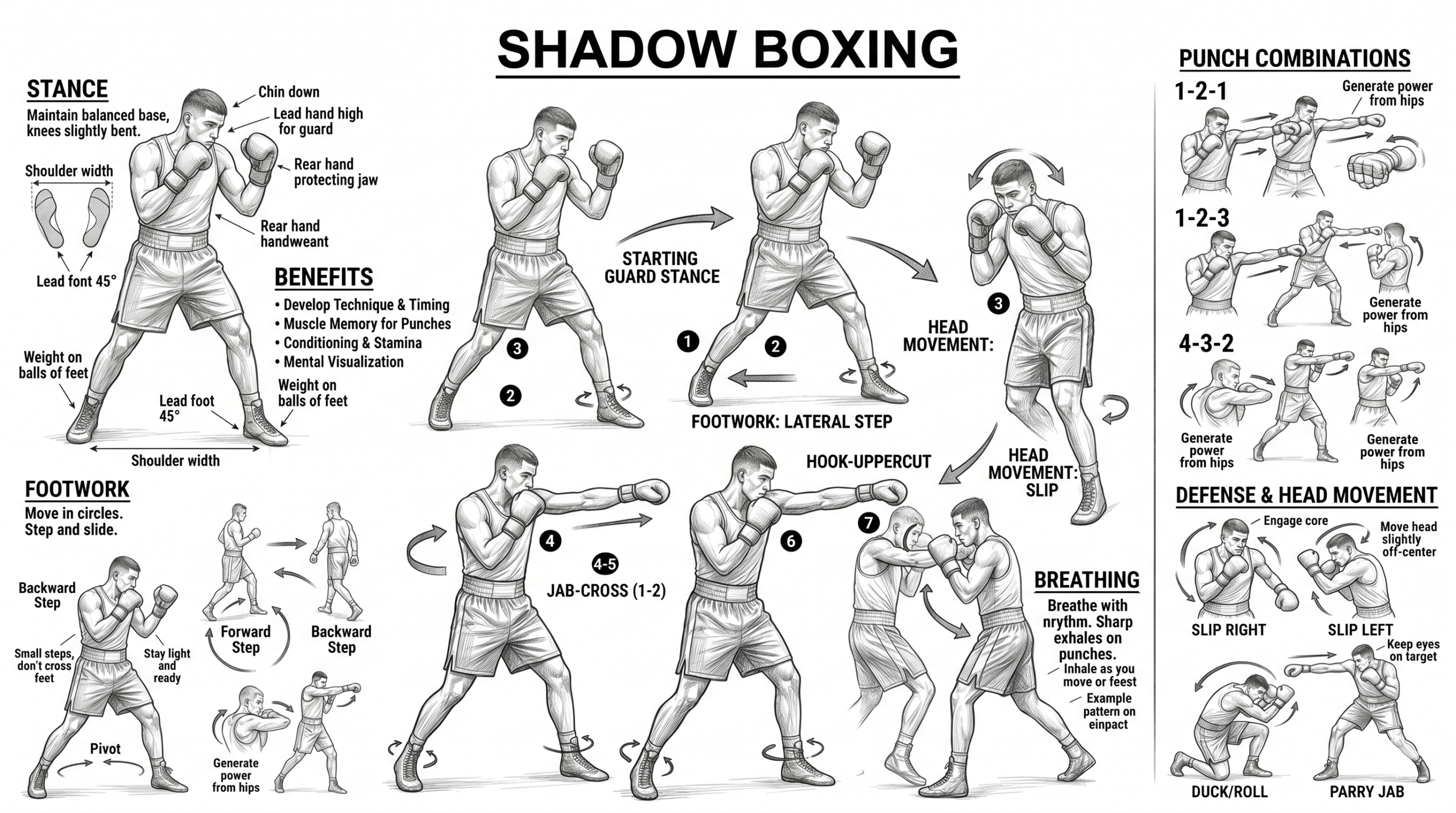
Shadow Boxing is one of the coolest exercise that you can perform.
It involves throwing punches and practicing footwork against an imaginary opponent.
How to do it
- Stand in a proper boxing stance with your hands up to protect your face
- Keep your feet shoulder-width apart and knees slightly bent
- Throw punches such as jabs, crosses, hooks, and uppercuts into the air
- Move around while maintaining balance and good posture
- Focus on speed, technique, and breathing
- Return your hands to the guard position after every punch
Target Muscles
- Shoulders (primary)
- Chest
- Triceps
- Core
- Legs (quads, calves, glutes)
Benefits
- Improves boxing technique and footwork
- Enhances cardiovascular endurance
- Burns calories and supports weight loss
- Increases hand speed and coordination
- Requires no equipment
Common Mistakes
- Dropping your hands after punching
- Standing flat-footed without movement
- Throwing punches with poor technique
- Holding your breath during combinations
Recommended Mistakes
- Beginners: 3 rounds x 1-2 minutes
- Intermediate: 3-5 rounds x 2-3 minutes
- Advanced: 5-8 rounds x 3 minutes
2. Jab (Lead Hand Punch)
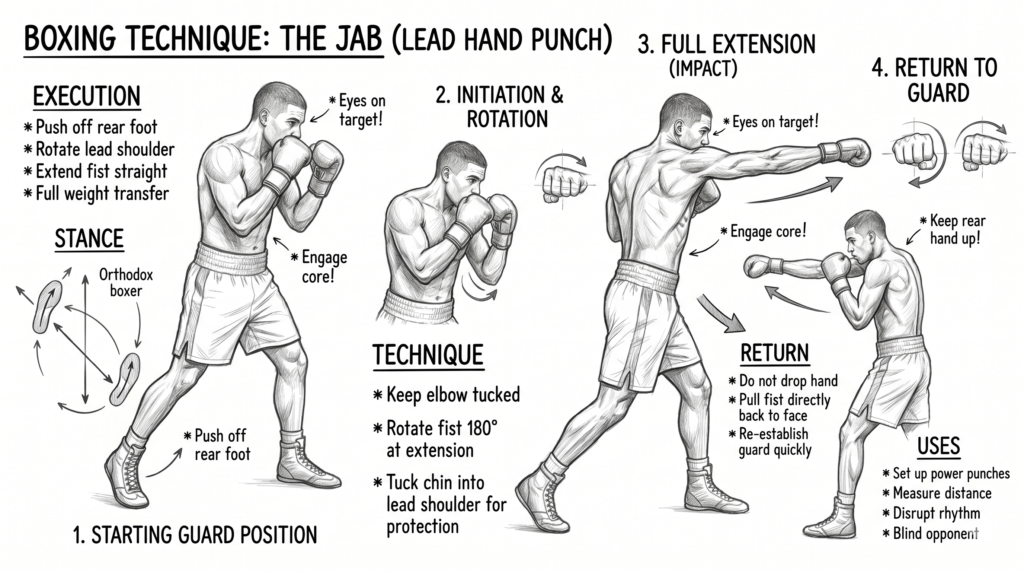
The jab is the first technique a beginner must learn. It is a quick straight punch thrown with the lead hand.
How to do it
- Stand in a boxing stance with your lead foot forward
- Keep your hands up to protect your face
- Extend your lead hand straight toward the target
- Rotate your fist so the palm faces downward at full extension
- Slightly rotate your shoulder forward to protect your chin
- Quickly retract your hand back to the guard position
Target Muscles
- Shoulders (primary)
- Triceps
- Chest
- Core
- Forearms
Benefits
- Improves hand speed and accuracy
- Helps establish distance and timing
- Builds shoulder endurance
- Sets up powerful punch combinations
- Enhances coordination and balance
Common Mistakes
- Dropping the opposite hand while punching
- Overextending the arm
- Leaning too far forward
- Returning the hand slowly to guard
Recommended Duration
- Beginners: 3 rounds x 30 seconds
- Intermediate: 3-4 rounds x 45 seconds
- Advanced: 4-5 rounds x 1 minute
3. Cross (Rear Hand Punch)
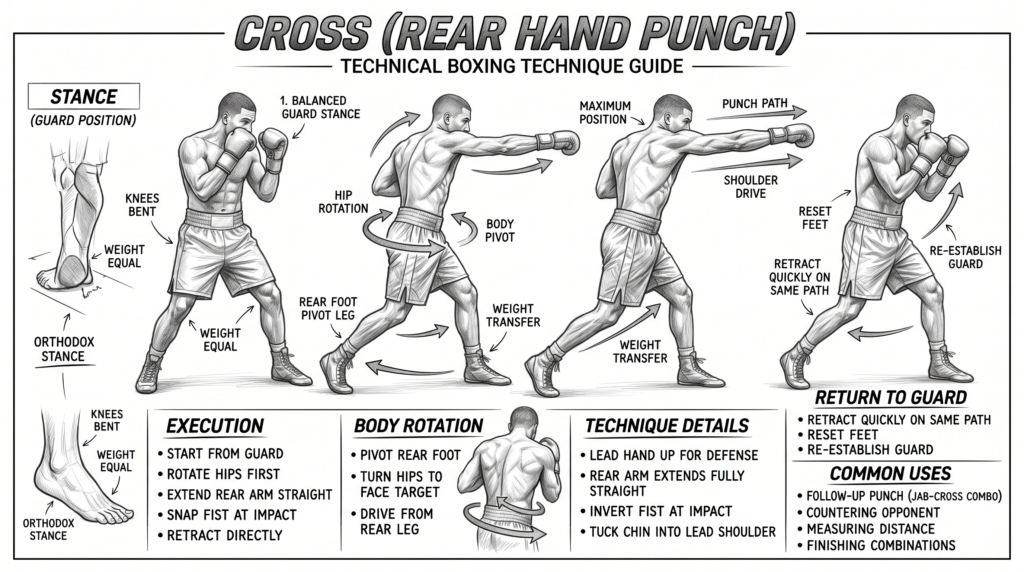
It is one of the most powerful punches in boxing. It is thrown with the back hand and uses the rotation of the hips, core, and shoulders to generate force.
How to do it
- Start in a proper boxing stance with your rear hand near your chin
- Pivot your back foot and rotate your hips and shoulders forward
- Extend your rear hand straight toward the target
- Rotate your fist so the palm faces downward at full extension
- Keep your lead hand up to protect your face
- Quickly return your rear hand to the guard position
Target Muscles
- Shoulders (primary)
- Chest
- Triceps
- Core (abdominals and obliques)
- Hips and legs
Benefits
- Develops punching power
- Strengthens the upper body and core
- Improves balance and coordination
- Enhances rotational strength
- Forms the foundation of many boxing combinations
Common Mistakes
- Throwing the punch using only the arm
- Failing to rotate the hips and back foot
- Dropping the lead hand during the punch
- Overreaching and losing balance
Recommended Duration
- Beginners: 3 rounds x 30 seconds
- Intermediate: 3-4 rounds x 45 seconds
- Advanced: 4-5 rounds x 1 minute
4. Hook Punch
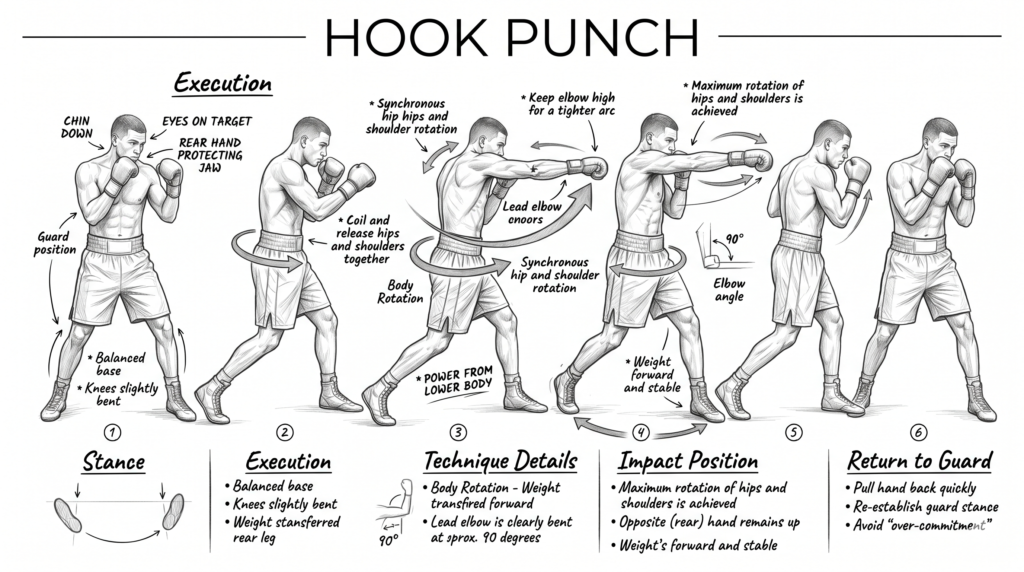
It is one of the powerful punches thrown to the side of the head. It generates force through the rotation of the hips, core, and shoulders which makes it one of the most effective punches in boxing.
How to do it
- Start in a proper boxing stance with your hands up in guard position
- Bend your elbow to about 90 degrees
- Rotate your hips and shoulders as you swing your arm in a horizontal arc
- Keep your elbow level with your fist throughout the movement
- Pivot your lead foot to generate power
- Return your hand quickly to the guard position
Target Muscles
- Shoulders (primary)
- Chest
- Obliques
- Core
- Biceps and forearms
Benefits
- Increases punching power
- Develops rotational strength and core stability
- Improves coordination and balance
- Effective for close-range boxing combinations
- Enhances overall boxing performance
Common Mistakes
- Swinging the arm too wide
- Dropping the opposite hand from guard
- Failing to rotate the hips and feet
- Overextending the punch
Recommended Duration
- Beginners: 3 rounds x 30 seconds
- Intermediate: 3-4 rounds x 45 seconds
- Advanced: 4-5 rounds x 1 minute
5. Uppercut
The uppercut is a powerful upward punch used in close-range boxing. It targets an opponent’s chin and generates force through the legs, hips, and core.
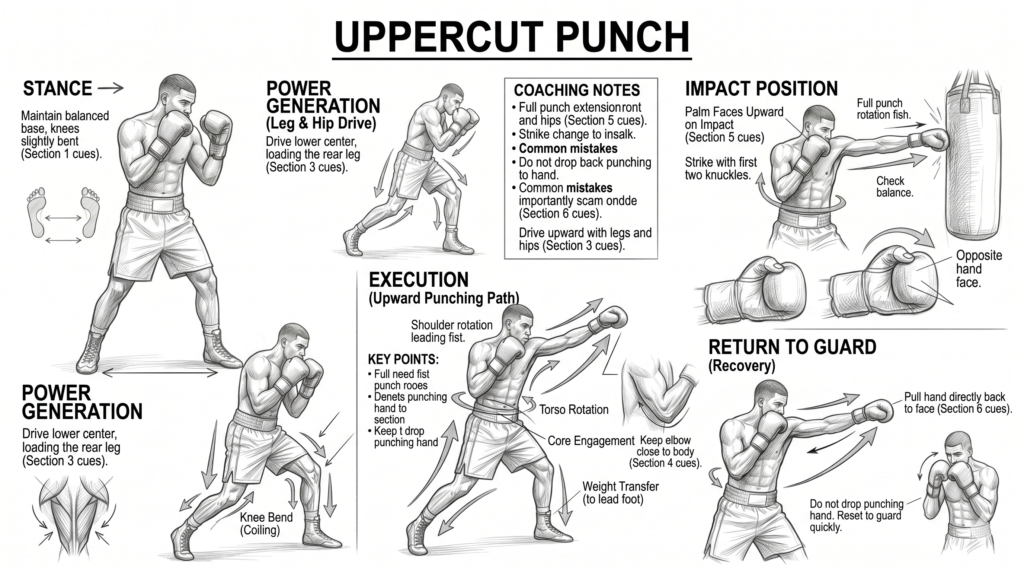
How to do it
- Start in a boxing stance with your hands up in guard position
- Slightly bend your knees and lower your body
- Rotate your hips and shoulders while driving your fist upward
- Keep your elbow bent and close to your body
- Aim the punch in an upward arc toward the target
- Return your hand quickly to the guard position
Target Muscles
- Shoulders (primary)
- Biceps
- Chest
- Core (abdominals and obliques)
- Legs (quads and glutes)
Benefits
- Develops explosive punching power
- Strengthens the core and upper body
- Improves coordination and balance
- Effective for close-range boxing situations
- Enhances overall punching combinations
Common Mistakes
- Dropping the opposite hand from guard
- Using only the arm instead of the legs and hips
- Overextending the punch
- Leaning too far forward during the movement
Recommended Duration
- Beginners: 3 rounds x 30 seconds
- Intermediate: 3-4 rounds x 45 seconds
- Advanced: 4-5 rounds x 1 minute
That is all the best exercises for boxing at home. If you want to learn more exercises related to boxing, you can find them on my blog page.